

° ° “What are these floating dots???” ° °
I was a bit shocked to interact with a New Testament scholar who was asking me what the various sigla in Nestle-Aland 28 meant, such as ⸀ ° ⸆ ⸋ ⸌ ⸉ ⸊
It soon became clear to me that this person didn’t know how to read the NA28 apparatus.
To be fair, this person’s area of research and dissertation were not in textual criticism, but regardless — anyone with a PhD in New Testament should be able to read and use the NA28 apparatus.
I suspect that there may even be professors and teachers who learned how to read NA27/28 during their MDiv or PhD studies, but have now forgotten because they don’t practice textual criticism very much.
I don’t want to pass judgment since there are plenty of things outside my own research interests that I don’t understand well. We all have our own areas of interest and areas of weakness. I’m thankful to be able to ask experts in other fields to explain their areas of expertise to me as if I’m a five year old 😬

So this is my attempt to write a “for dummies” guide to the NA28 textual apparatus. And I hope to reach the widest possible audience and to explain in the simplest way possible.

However … don’t tune out if you already know how to use NA28’s apparatus. Those who already know how to use NA28’s apparatus might learn some “advanced” features that are less well-known (e.g. the listing of “minor” variants, the punctuation apparatus, the accent apparatus).
But first — why is a “for dummies” guide to the NA28 apparatus even necessary?
Three reasons:
(1) Many people read the Greek New Testament without ever looking at an apparatus.
A while back, I spoke with a friend of mine from seminary, who was a senior pastor. We went to the Master’s Seminary together from 2008-2011, where two full years of Greek were required. He really was trying hard to keep up his Greek — albeit by using Bible software (which I still think is better than nothing, pardon the blasphemy 😬).
I couldn’t resist the urge to chime in and ask if he ever used the NA28 textual apparatus and did some textual criticism during sermon prep.
He said, “Oh, I didn’t know you could see the apparatus in my Bible software.”
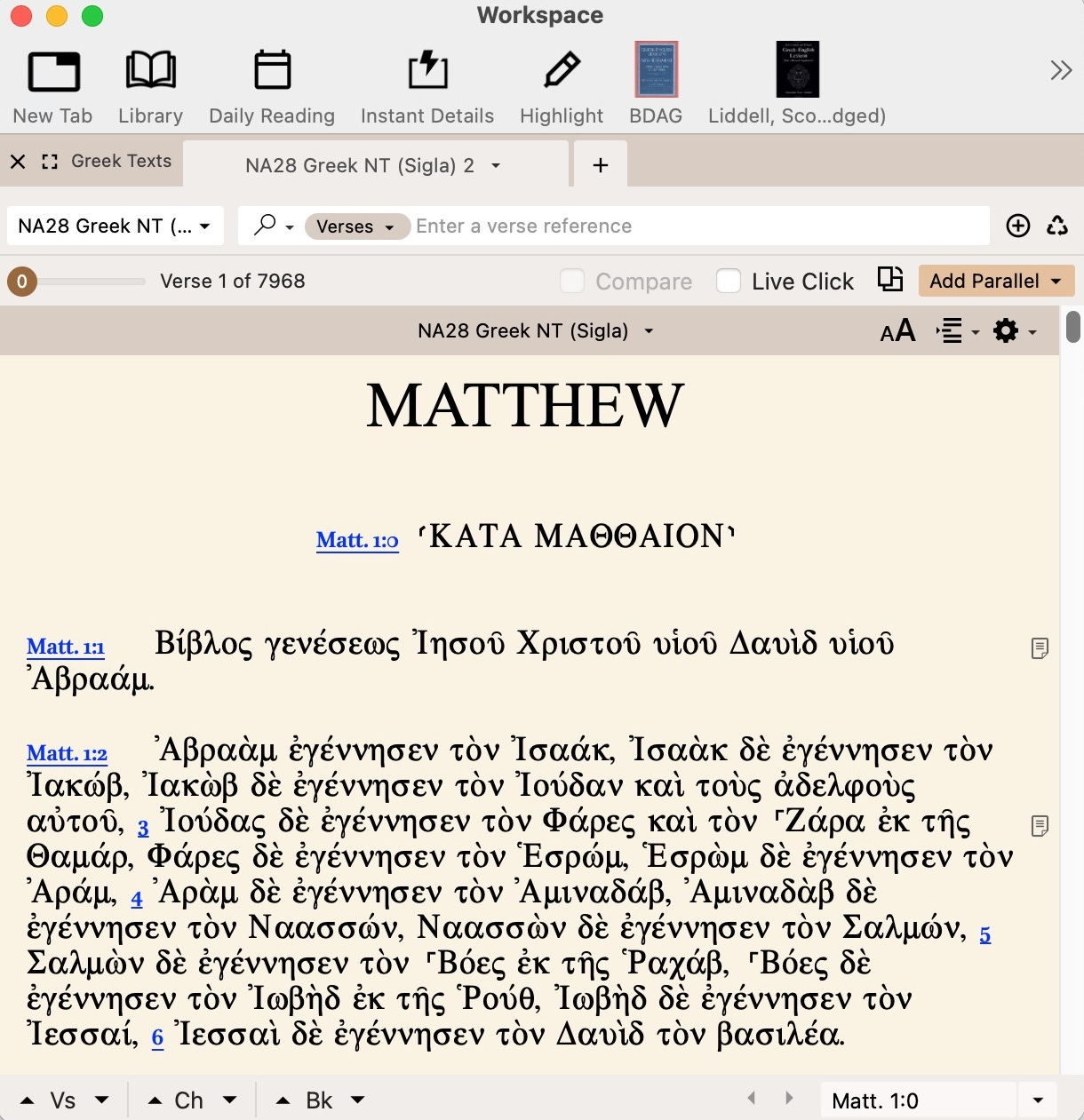
In Accordance Bible software, the NA28 text and the NA28 apparatus are two separate modules, so by default — the NA28 text opens without an apparatus. And so, most people won’t make the extra effort to open the apparatus module (I’m not a Logos Bible software user, so maybe someone can tell me if Logos does the same).
In contrast, it is impossible to dodge the apparatus in a physical copy of NA28.
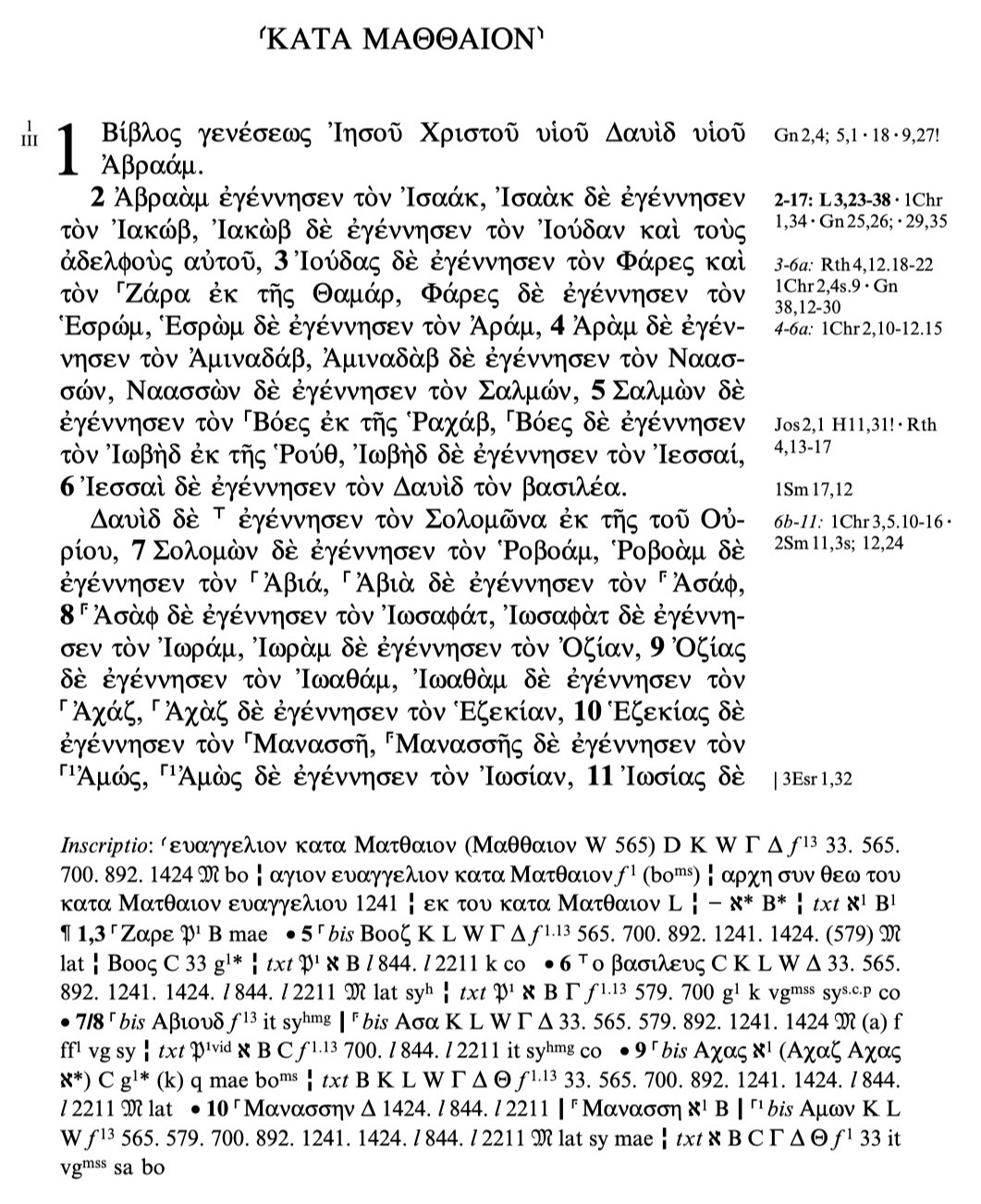
But we all know that reading in general is becoming digital, so I think most people probably don’t even own a physical copy of NA28 (and it’s expensive too!). Rather, most people will read NA28 in Bible software, where they may never even open the apparatus module.
I know a lot of Greek classes still require students to buy a physical copy of the Greek New Testament, although I so often see students who finish their MDiv and immediately sell a lot of their textbooks. This is understandable when most students move after seminary (I myself hate moving books!).
Maybe someone wants to lead a movement to Make Printed GNTs Great Again. If so, I say: “May the odds be ever in your favor.”
Another manifestation of the trend of reading the GNT without apparatus can be seen in the popularity of Reader’s Editions of the Greek New Testament (the Zondervan edition and the Tyndale House edition seem to be most popular).
Because these Reader’s Editions have parsing and vocab aids in the lower margin, they don’t have space for a textual apparatus. So users will read the GNT without encountering an apparatus.
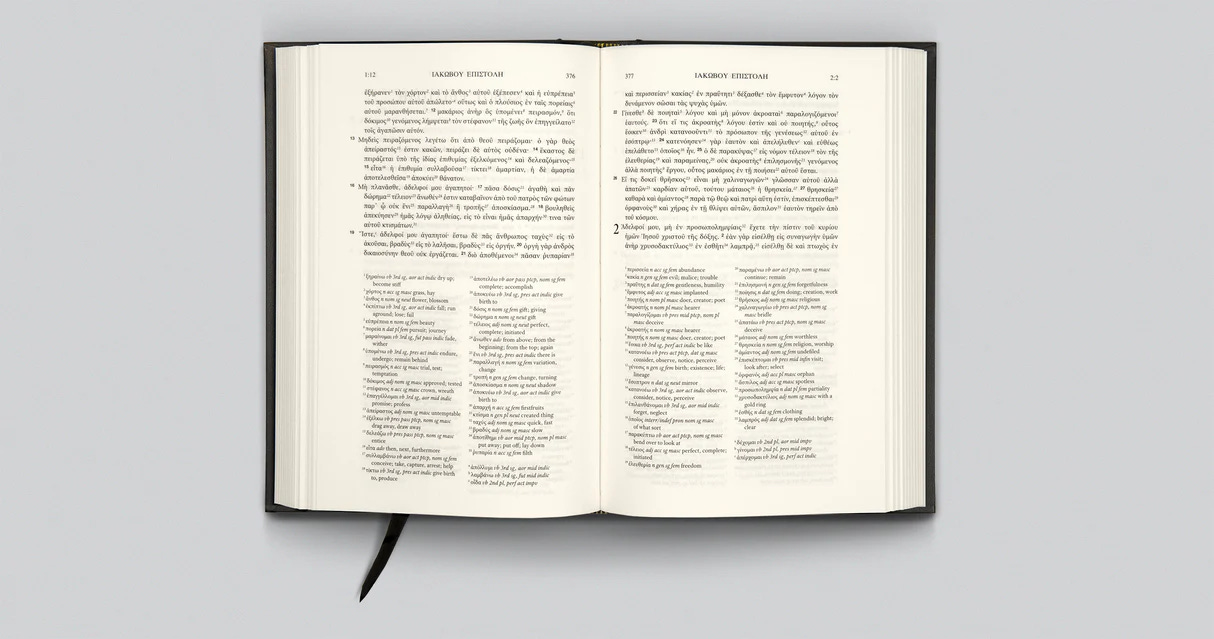
These two trends — reading NA28 in Bible software and using a Reader’s Edition of the GNT — lead most people to read the GNT without even seeing a textual apparatus.
But I suspect that part of the reason for avoiding the NA28 apparatus is simply because it looks intimidating and people don’t know how to use it.
(2) Biblical-theological training tends not to require much study of textual criticism.
I don’t know this for sure (chime in if you are a prof), but I think undergrad and grad students are getting less and less teaching on textual criticism.
I looked at past syllabi of our NT survey class here at New Orleans Baptist Seminary, and students get only one lecture on textual criticism in their whole MDiv (unless they take a textual criticism elective). And the required textbook for NT Survey only gave an overview of the discipline, with no explanation of the NA28 apparatus.
Even I’m only giving one lecture on textual criticism in my NT survey class because there is so much other material to cover.
This is unfortunate because:
Most people are highly unlikely to teach themselves how to read the NA28 apparatus because it’s so technical and complex.
Even New Testament PhDs/profs are probably too embarrassed to ask for help — so a “for dummies” guide doesn’t seem to be needed.
But as any good teacher should say to students: there are no stupid questions.
(3) While material already exists that explains the NA28 apparatus, it is complex and/or very brief.
NA28’s own introduction and appendix 1 explain its own apparatus (pp. 54*-61* and 879-90). And there is also some secondary literature that explains the NA28 apparatus.1
But most of these resources don’t actually walk through the full process and “translate” the sigla into language for normal people (although see the exceptions in the videos in footnote 1 above).
In two years of New Testament Greek during my MDiv and even in my PhD studies(!), I was never required to read the NA28 Introduction.
But even if students read the NA28 Introduction, the introductory material is written by the editors who are experts in textual criticism, who already understand what they have created, and who haven’t written their introduction at a “popular” level. This is not meant as a criticism since NA28 is a scholarly tool, so it should be explained at a scholarly level that is beyond the level of most students.
A great exception to this trend is the highly accessible and easy-to-read introduction by Dirk Jongkind, An Introduction to the Greek New Testament, Produced at Tyndale House, Cambridge (Crossway, 2019). But Jongkind obviously doesn’t cover NA28.
As for myself — I learned to “translate” an apparatus through repeated practice and in a class with Septuagint scholar Peter Gentry. I still fondly remember taking Gentry’s class on the Septuagint and him requiring us to read and explain the Göttingen LXX apparatus in class:
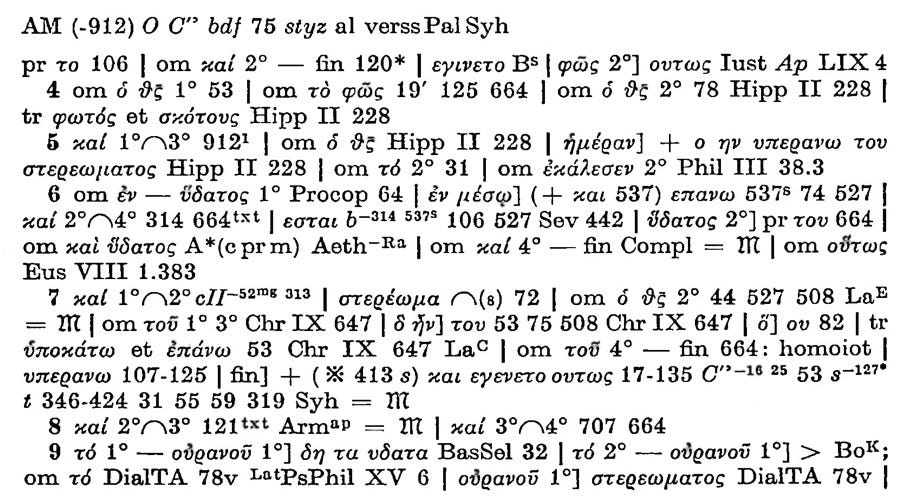
What class participation entailed was “translating” all the information in the tightly packed apparatus. And one line of apparatus would take several minutes to explain and would require a lot of flipping back and forth to the Einleitung (introduction), which was written in German. (p.s., I love the kophleiste feature in the Göttingen LXX, which Tregelles’ GNT also did — listing all the manuscripts extant for the variants on each page).
This seemed so basic, but we were nervous and initially had no idea what we were doing. Correct me if I’m wrong, but I think the Göttingen LXX apparatus is the most difficult textual apparatus to read. A few years back, I even had a senior NT scholar email me and ask for help in reading the Göttingen LXX apparatus; that was definitely a demonstration of humility and I was glad to help.
So if you want to have some fun after mastering the NA28 apparatus, climb the Mt. Everest of apparatuses and read the Göttingen LXX apparatus. 😬
Let’s get into an overview of NA28’s textual apparatus
This article has 6 parts, which explain:
The text-critical sigla in NA28’s text and apparatus such as ⸀ ° ⸆ ⸋ … ⸌ ⸉ … ⸊
The sigla/abbreviations for manuscripts, versions, and church fathers
NA28’s apparatus layout: lemma + textual variations
The punctuation and accentuation apparatus in NA28
Using the NA28 apparatus in Accordance Bible Software
Two examples from Ephesians 1:1, where everything is explained
1. The text-critical sigla in NA28’s text and apparatus
The first thing anyone needs to know are the sigla and some of the most common abbreviations used in NA28.
“Sigla” (the plural of “siglum”) are signs and symbols used to denote other words.
Sigla are not the same thing as abbreviations (like om. for omit); sigla are symbols or signs (for example, NA28 uses the siglum ° for a one-word omission).
To understand the purpose of sigla, we must first recognize that in textual criticism, there are really only four types of textual variation:
Addition
Omission
Transposition (word order change)
Substitution
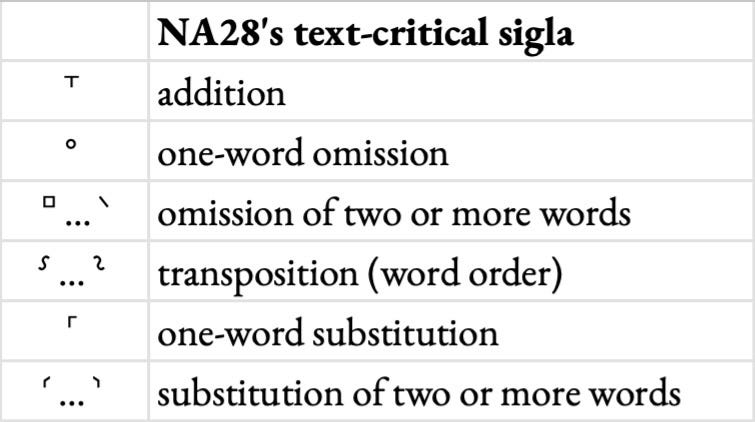
NA28 represents these four types of textual variation with 6 sigla:
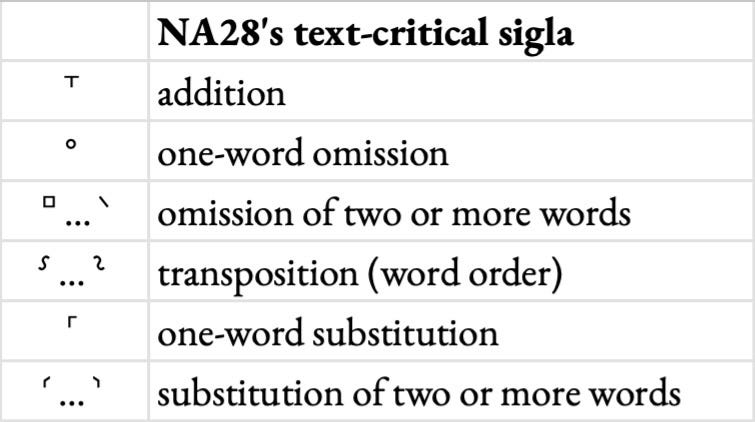
Why does NA28 have 6 sigla to cover 4 types of textual variation? Because omissions and substitutions are sub-divided into omissions/substitutions of one-word and of two or more words.
Note that three of these sigla are pairs: ⸋ … ⸌ ⸉ … ⸊ ⸂ … ⸃
In the main text, you will always need to look for the second part of the pair
However, in the apparatus — only the first part of the pair will be found: ⸋ ⸉ ⸂
The substitution of two or more words ⸂ … ⸃ can get tricky in some instances, where italicized numerals are used to represent the words
For example, in Mark 1:2 we see — ἐν ⸂ τῷ Ἡσαΐᾳ τῷ προφήτῃ ⸃
The first textual variant in the apparatus reads: ⸂ 2 3 4 ⸃
There are four words in this variant ⸂ τῷ Ἡσαΐᾳ τῷ προφήτῃ ⸃ so what 2 3 4 mean is that the variant has words 2-4, namely: Ἡσαΐᾳ τῷ προφήτῃ (the first word, τῷ is omitted).
A final comment about text-critical sigla — Christian Askeland has a great blog post on most of the sigla used in textual criticism:
I previously would copy & paste from his blog post, but I have now created my own list of symbols/sigla for textual criticism; I have added many more things beyond his list (e.g., complex Greek numerals like the sampi and koppa, ECM Revelation’s special sigla for textual divisions, sigla unique to the Göttingen LXX, and Greek punctuation).
2. Explanation of the sigla/abbreviations for manuscripts, versions, and church fathers
The other sigla/abbreviations (which you must know to read NA28’s apparatus) are those which indicate witnesses that support each textual variant, namely:
manuscripts
church fathers, and
“versions” (the early translations of the New Testament, such as Latin and Syriac).
2.1 PAPYRI
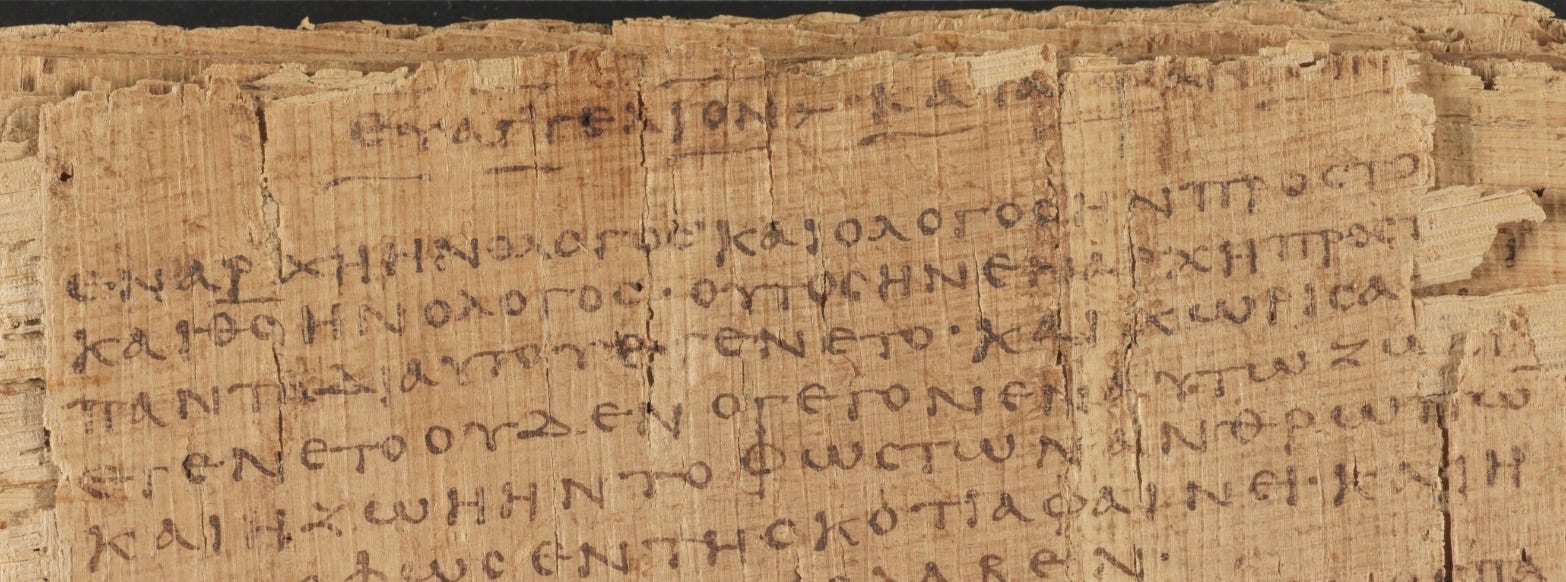
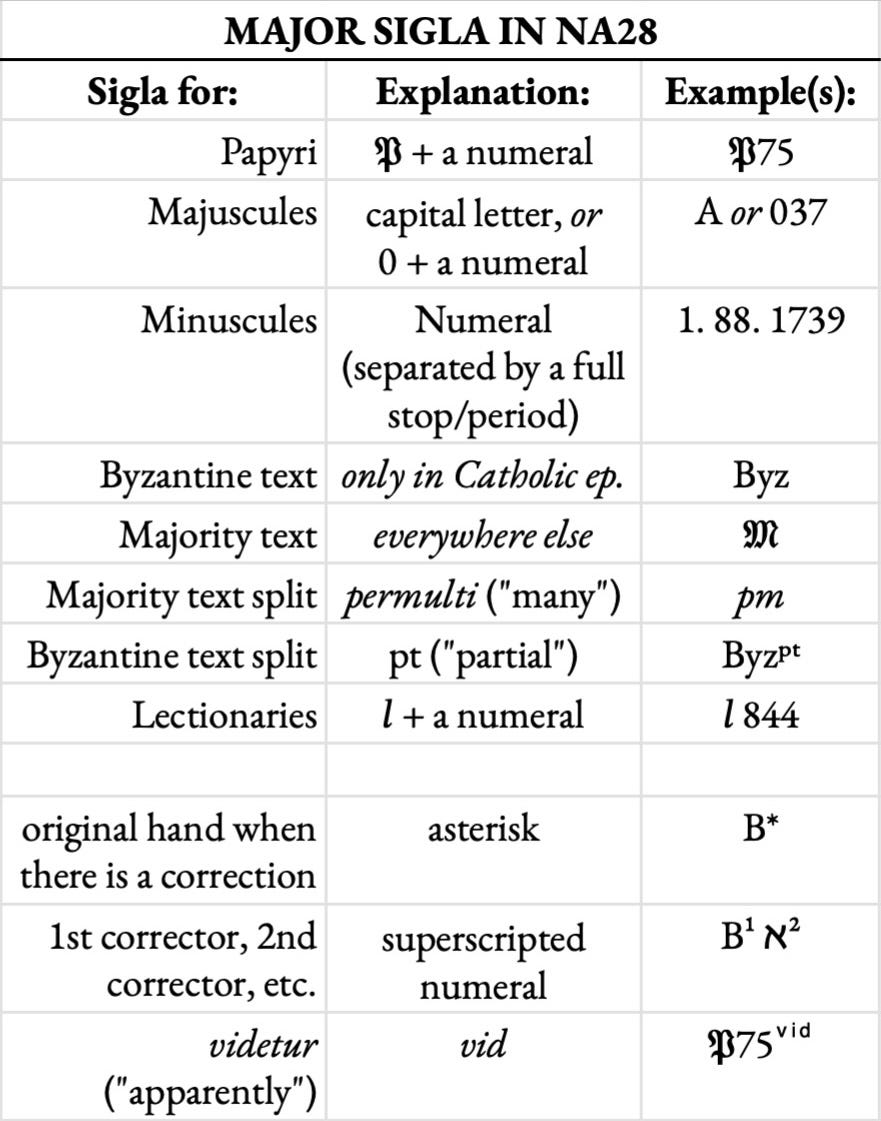
Papyrus manuscripts are indicated with: 𝔓 + a numeral (𝔓75 = papyrus 75).
Technically, papyri are written in majuscule script, so this group is described by its writing material not its script.
2.2 MAJUSCULES
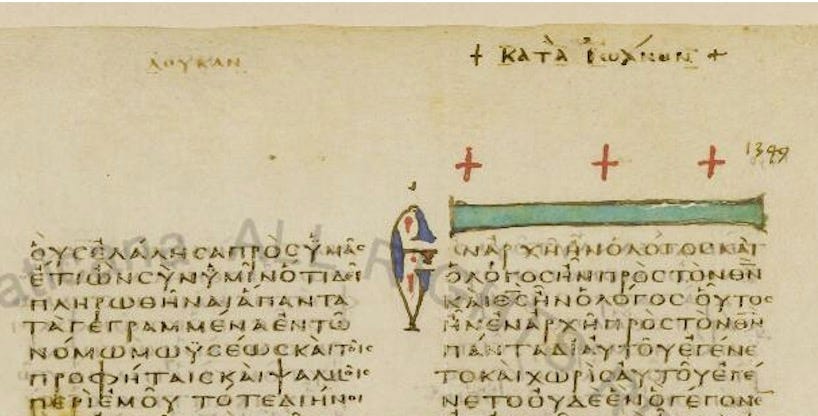
These manuscripts were written in a capitalized/upper case script (e.g. ΙΗΣΟΥΣ ΧΡΙΣΤΟΥ). These majuscules were written on parchment (animal skins), so this group is described by its script and not by its writing material (like with the papyri).
Many majuscule manuscripts are indicated by capital letters (A = Codex Alexandrinus; B = Codex Vaticanus; etc.).2 But there is an exception with Codex Sinaiticus, which is indicated by the Hebrew letter aleph (ℵ).3
Other majuscule manuscripts are indicated with 0 + a number (037, 0171, etc.). Although technically, all majuscules have 0 + a number (A = 02 = Codex Alexandrinus), but the NA28 apparatus still uses capital letters for the oldest majuscules. NA29 will switch to all numerals for majuscules.
2.3 MINUSCULES
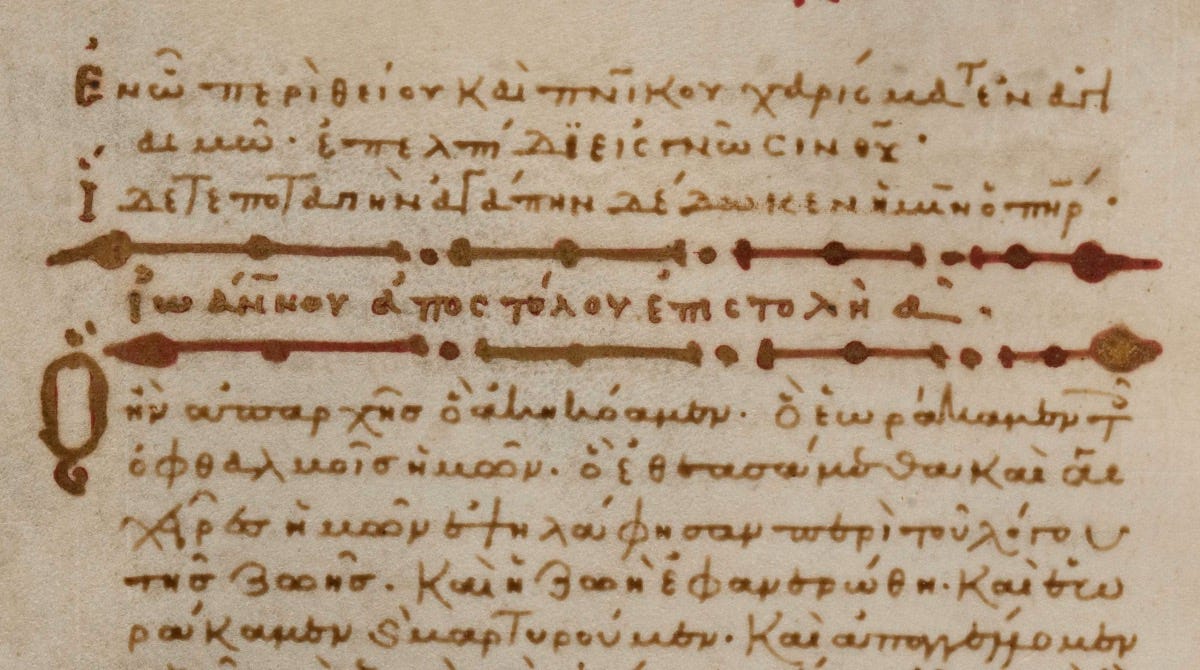
These manuscripts were written in a lower case/cursive script beginning in the 6th century, eventually becoming dominant in the 9th century onwards.4
Minuscule manuscripts are indicated by Arabic numerals (1, 337, 1739, etc.). Notice no zero in front to distinguish from majuscule manuscripts.
Minuscules are “grouped” in various ways in NA28:
Some minuscules are grouped into families (for example, family 1) and these use the siglum ƒ + a number (ƒ1 = family 1, ƒ13 = family 13).
NA28 uses the siglum 𝔐 to indicate the text of the majority of manuscripts, which will usually coincide with the so-called “Byzantine” text (but not always). Among surviving manuscripts, the super majority are minuscules.
Sometimes the Majority text is split (there is no clear majority), so NA28 uses the Latin abbreviation pm = permulti (“many”) to indicate the split. Two of these should appear in the variant unit.
In Revelation, the Majority text splits into two main groups: the Andrew text and the Koine text indicated by the sigla 𝔐ᴬ and 𝔐ᴷ
In only the Catholic Epistles of NA28 (which follow the abbreviations in the Editio Critica Maior), the siglum 𝔐 is no longer used, but rather the abbreviation “Byz” instead. When the Byzantine text is split, you will see Byzᵖᵗ for two different readings to show the split.
2.4 LECTIONARIES
These are indicated with the siglum 𝑙 + a numeral (so, 𝑙 844 = lectionary 844).
Lectionaries are written in minuscule script, so these manuscripts are categorized according their function and not their script.
2.5 VERSIONS AND CHURCH FATHERS
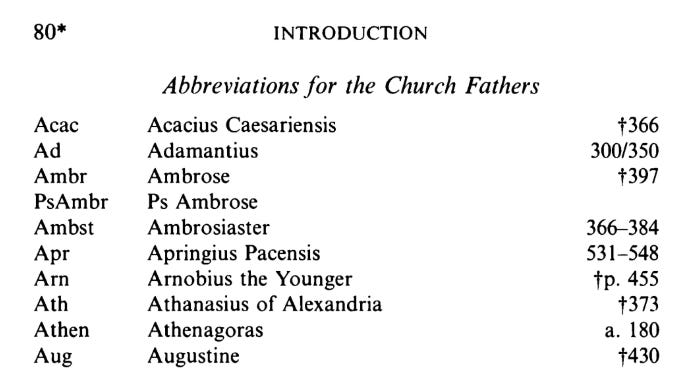
For the versions (Latin, Syriac, etc.) and for the church fathers, there is a list of their abbreviations in NA28’s introduction on pp. 67*-81*.
Information about the versions and patristic evidence can be found in Bart D. Ehrman and Michael W. Holmes, eds., The Text of the New Testament in Contemporary Research: Essays on the Status Quaestionis, NTTSD 42 (Brill, 2013).
2.6 WHERE TO FIND INFORMATION ABOUT MANUSCRIPTS
You can find basic descriptions of each manuscript in the NA28’s Introduction, pp. 61*-81* as well as on pp. 792-819 (which is Appendix I). NOTE: the pagination in NA28’s Introduction is always written with an asterisk, hence 61*-81*
NA28’s information on each manuscript is very basic (date, contents, holding library). This is not a criticism since NA28 is a one-volume hand edition.
Much fuller information and bibliography on each manuscript can be found using the INTF’s Liste; type in the manuscript’s abbreviation in the “Name” field (such as P75, 03, 1739). And you’ll be provided with very full information on the manuscript. Although I think the Bibliography provided is a bit over the top; if the manuscript is mentioned in even just one or two pages of a book/article, that book/article will be listed.
NOTE: capital letters for majuscules (such as A, C, D) will not work in the Liste; only numbers with a zero in front (A, C, D = 02, 04, 05).
2.7 THREE MORE IMPORTANT SIGLA/ABBREVIATIONS
There are many more sigla and abbreviations, but I want to explain three more that I think are important to know in order to read the NA28 apparatus well:
(1) A manuscript with an asterisk * indicates the original reading (the first hand) in a manuscript where this is a correction. For example: B* means the original reading or first hand of B (Codex Vaticanus). These asterisked readings should always be accompanied by a corrected reading (but sometimes are not, like when there is only a negative apparatus, i.e. witnesses for the main text are omitted).
(2) Many corrected readings are indicated by a superscripted number such as B¹, B², B³ = the first, second, and third correctors of B (Codex Vaticanus). NA28 describes these correctors in its introduction on p. 59*. These should always be paired with an asterisked number (but sometimes are not).
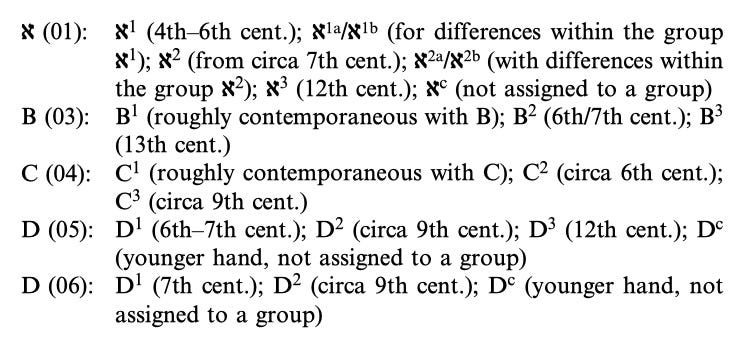
The date and quality of these correctors are hotly debated, which is why…
NA28’s description of correctors should be supplemented by specialized studies on correctors, such as The Codex Sinaiticus Project website and Dirk Jongkind for Codex Sinaiticus, Jesse Grenz and Pietro Versace for Codex Vaticanus, and David Parker for Codex Bezae.5 There are also several studies of correctors in papyri or just focused on one specific passage.6 These specialized studies will often differ from NA28’s assessment of correctors.
Some corrected readings are not specifically identified into groups (B¹, B², B³), so just a superscripted ᶜ is used such as 037ᶜ
(3) Sometimes a manuscript is damaged or faded and so the editors were uncertain about the precise transcription/reading in the manuscript. Editors indicate such palaeographic uncertainty with the Latin abbreviation vid = videtur (“it seems, it appears”), which will be superscripted, for example: 𝔓64 ͮ ͥ ͩ
TL;DR SUMMARY:
2.8 THE NA28 INSERT
The abbreviations for manuscripts and versions, the Latin abbreviations, and the text-critical sigla are also found in the small insert that accompanies NA28 (which is easy to slip out and lose!).
But the list of church fathers is only in NA28 Introduction, pp. 80*-81* and not on the insert 🥲
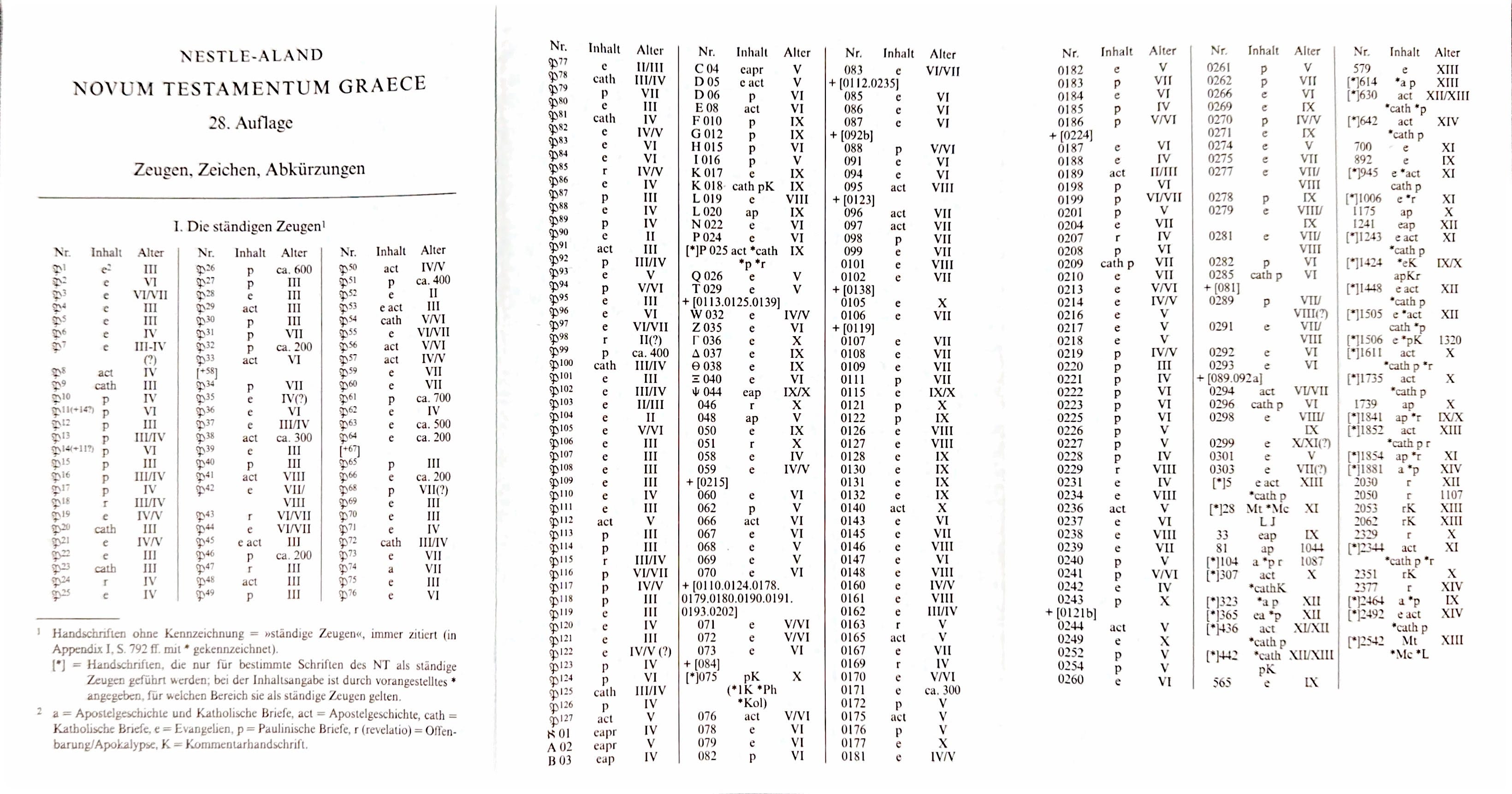
Click here for a PDF of the NA28 insert (which you can print out if you lost yours!). There is an English version, then a German version.
3. NA28’s apparatus layout: lemma + textual variations
3.1 HOW NA28 PRESENTS VARIANTS

The lemma is the heading of a variant unit. Put another way, the lemma is the text adopted by the editors and printed in the main text.
In NA28, the lemma is at the end of the entry and is indicated by the abbreviation txt.
Before the lemma, NA28 lists the textual variants differing from the lemma.
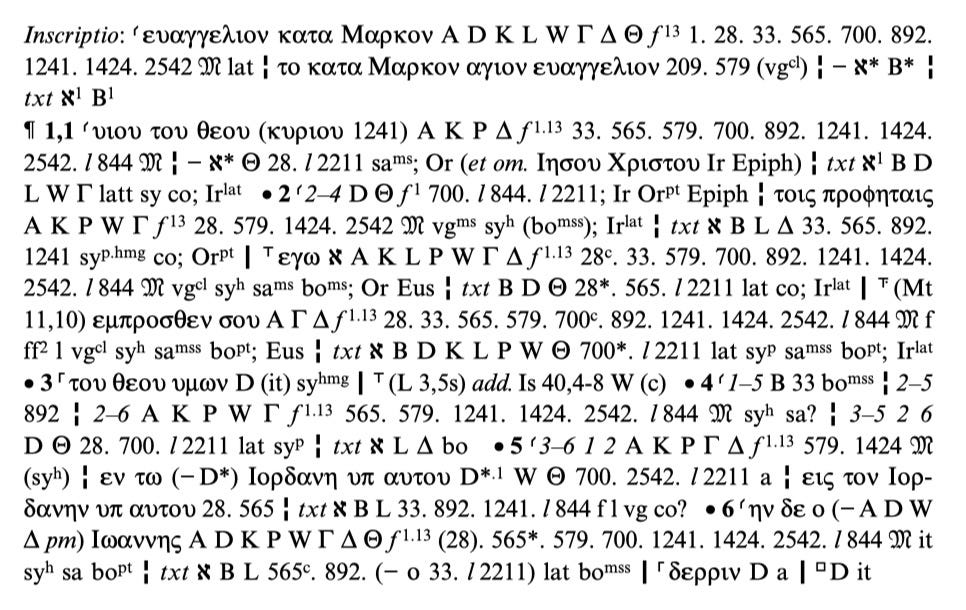
For example, in the case of the famous Mark 1:1 ‘son of God’ variant, the text (lemma) adopted in NA28 is υἱοῦ θεοῦ, but four other variants are listed:
lemma: υιου θεου
variant 1: υιου του θεου
variant 2: υιου του κυριου
variant 3: omit the lemma
variant 4: omit the lemma and omit the preceding two words (Ιησου Χριστου)
But … this is not how NA28’s apparatus presents the evidence.
This is what the NA28 apparatus looks like at Mark 1.1:

The lemma (main text) is placed at the end of the entry with the abbreviation txt.
The variants precede the lemma and each variant is separated with a broken vertical line ¦
The parentheses (…) indicate minor variants, which I will explain later.
3.2 HOW OTHER EDITIONS PRESENT VARIANTS
Older editions (Tischendorf, Legg), the United Bible Societies Greek New Testament, 5th ed. (UBS5), and the Tyndale House Greek New Testament (THGNT) also use a lemma + variations format.
But the lemma is placed first and the variants come after the lemma (instead of before the lemma in NA28).
For example, in Mark 1:1, the THGNT looks as follows:

The lemma (υιου θεου) is in bold and comes first (instead of last in NA28). Elsewhere, you will see the lemma separated by a left-facing square bracket … ] like in the Göttingen LXX.
The textual variants in the THGNT are separated by a semi-colon (instead of ¦ in NA28). And there is only one abbreviation in the THGNT: vid for videtur (“apparently”). Thus, you will find omit in the THGNT (instead of om. in NA28); before in THGNT (instead of a. in NA28 for Latin ante); and after in the THGNT (instead of p. in NA28 for Latin post).
Finally, there is only one sigla in the THGNT — the diamond ◆ — which indicates uncertainty for the variant it is paired with (e.g. ◆ omit in Mark 1:1). In contrast, NA28 uses square brackets [ … ] for uncertainty, while the Editio Critica Maior / Catholic epistles in NA28 also use a diamond ◆ for uncertainty, like the THGNT.
3.3 HOW NA28 INDICATES “MINOR VARIANTS”: METHOD #1
Technically, based on the two ¦ in the NA28 apparatus for Mark 1:1, there would seem to be only two variants listed. However two additional “minor” variants are added in parentheses:

The first minor variant is on the first line after υιου του θεου, where we see:
(κυριου 1241)
This means that there is a minor variant in minuscule 1241 that makes a substitution for the preceding word: κυριου is substituted for θεου. But this is a sub-variant of υιου του θεου, so the full reading in minuscule 1241 is υιου του κυριου (vs. υιου θεου in NA28).
You can see how it takes me 99 words to explain 2 words in NA28’s apparatus!
NOTE: with minor variants, you will see:
+ for an addition
- for an omission
no sigla indicates a substition with the previous word, for example: υιου του θεου (κυριου 1241) in the example above means that θεου is substituted with κυριου in minuscule 1241.
The second minor variant is on the second line.

We see:
(et. om. Ιησου Χριστου Ir Epiph)
Several abbreviations and sigla need explaining here:
There are two church fathers mentioned (Ir = Irenaeus, Epiph = Epiphanius); see pages 78*-81* in NA28’s Introduction for abbreviations of the church fathers (NOTE: the pagination of the NA28 Introduction has an asterisk after each page number).
This minor variant is found within the variant omitting the lemma (υιου θεου); NA28 indicates the omission of υιου θεου by using a dash –
NOTE: NA28 goes back and forth between a dash – and om. to indicate omission
The actual minor variant is described as et. om. Ιησου Χριστου. The Latin word et means “and.” The abbreviation om. is Latin for omittit/omittunt which means “omit” or “omits.” Latin abbreviations are explained in NA28’s Appendix IV, pp. 885-90.
In summary, the second minor variant in Mark 1:1 — (et. om. Ιησου Χριστου Ir Epiph) — indicates that Irenaeus and Epiphanius omit υιου θεου and also omit Ιησου Χριστου in Mark 1:1.
You can see how it took me 159 words to explain 6 words in NA28!
3.4 HOW NA28 INDICATES “MINOR VARIANTS”: METHOD #2
NA28 has a second method of indicating “minor” variants and we can see an example in Mark 1:8:

The siglum ⸆ indicates that the variant concerns adding the preposition ἐν before ὕδατι in Mark 1:8 (maybe an attempt to make a plain dative ὕδατι more explicit, which is the norm in Koine Greek).
Among all the witnesses given, notice that D (= Codex Bezae) is in parentheses: what is NA28 indicating here?
As seen earlier, parentheses indicate a minor variation from the main variant that it is found within (in this case, adding the preposition ἐν before ὕδατι).
But there is no additional information inside the parentheses other than the witness D (= Codex Bezae). The earlier minor variant we saw in Mark 1:1 had et. om. Ιησου Χριστου, but there is no additional information here in Mark 1:8.
In this case, we have to turn to Appendix II (Variae lectiones minores) in NA28, pp. 820-35, which lists “minor textual variants from Greek codices, which the critical apparatus puts in parentheses” (this heading is written in Latin in NA28: Variae lectiones minores e codicibus graecis quos apparatus criticus in parenthesi exhibet).
Within Appendix II, we look for Mark 1:8 and find this:

There are four Latin words here (again, you can find Latin abbreviations in NA28’s Appendix IV, pp. 885-90):
sed means “but”
pon. is a Latin abbreviation for ponit/ponunt meaning “put” or “puts”
a. is a Latin abbreviation for ante meaning “ahead of, before”
vs. is a Latin abbreviation for versus meaning “verse”
What all this is saying is — D (Codex Bezae) is considered part of the variant omitting the preposition ἐν before ὕδατι in Mark 1:8, but it has a minor variant where εγω μεν υμας βαπτιζω εν υδατι is placed before ερχεται in verse 7.
You can see how it took me 284 words to explain one word in NA28 at Mark 1:8! 🤣 😭
4. An explanation of the punctuation apparatus in NA28
This is not well-known, but NA28 also indicates alternative punctuation in its textual apparatus by using two raised up (supralinear) colons ܃ sample text ܃
An example can be found at Ephesians 1:4:
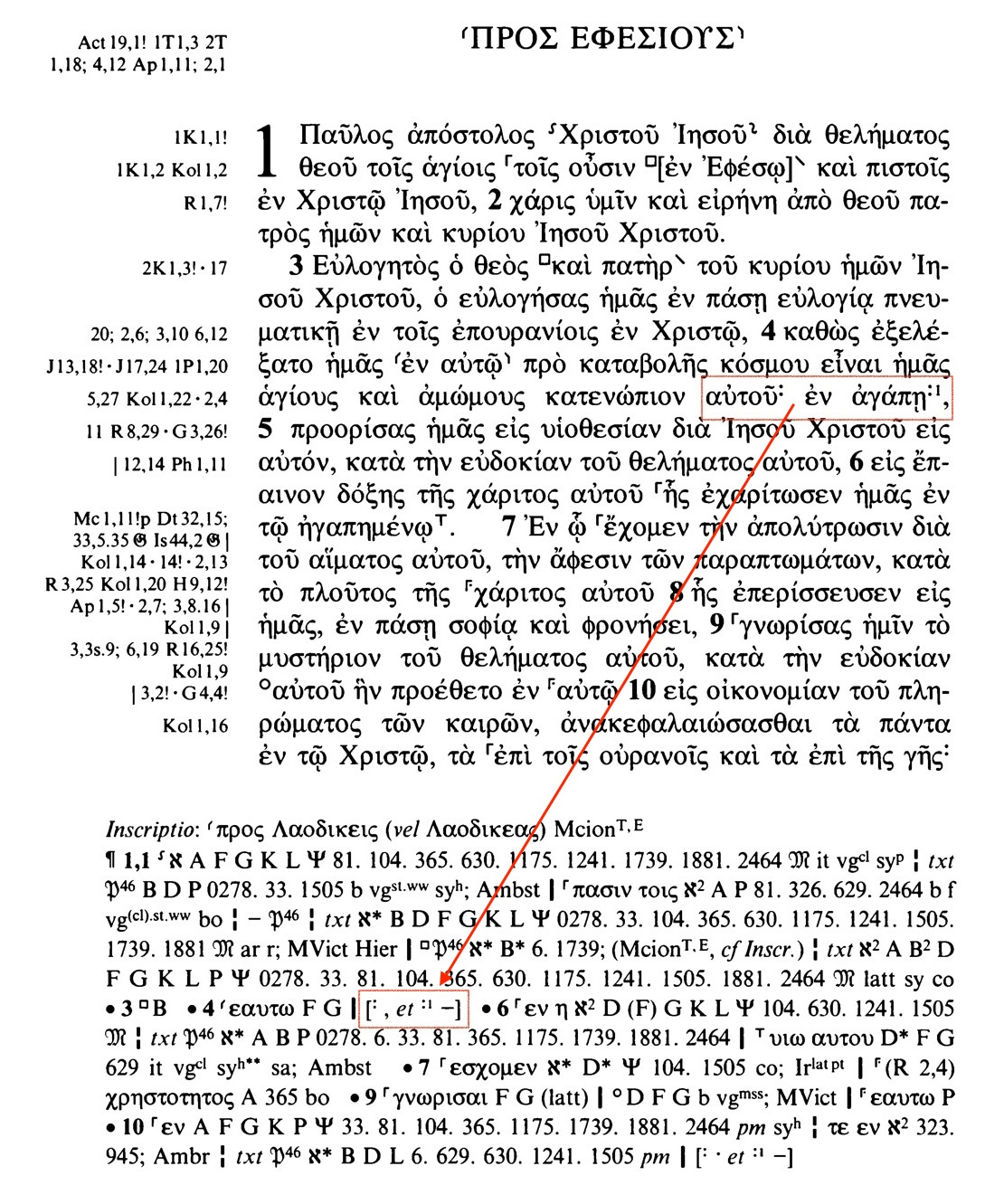
This is an interesting syntactical issue that has a substantial impact on interpretation and is discussed in most exegetical commentaries.
Does ἐν ἀγάπῃ at the end of Eph 1:4 belong with what comes before, or with what comes after?
Is God acting so that Christians become “holy and blameless before him in love”?
Or has God “in love, predestined us to adoption through Jesus Christ”?
NA28’s main text has a comma after ἐν ἀγάπῃ, which forces the reader to understand ἐν ἀγάπῃ as belonging with what comes before (option #1 above).
But NA28’s apparatus has a punctuation alternative here where a comma is placed before ἐν ἀγάπῃ and the comma after ἐν ἀγάπῃ is removed (option #2 above).
This is indicated both in the text with two supralinear colons ܃ ἐν ἀγάπῃ ܃

And in the apparatus, the punctuation alternative is indicated inside square brackets [ … ], as can be seen below:

The comma means to add a comma after the first ܃
The dash means to remove the existing punctuation in the main text after ἐν ἀγάπῃ
I have a small list of punctuation apparatus entries in NA28: Matt 4:15; 7:11; 8:7; 11:7, 8; 25:15/16; 26:44; 27:11; Mark 2:15; John 1:3/4; 8:25; 16:31; Eph 1:4, 10; 5:20/21; 1 Tim 3:1; Rev 9:12/13. But this is far from comprehensive.
Does anyone else have a list of punctuation apparatus entries in NA28?
Furthermore, NA28 also has apparatus entries on alternative accentuation. Greek students learn that for liquid verbs (such as κρίνω), the difference between the future and the present tense-form is solely determined by accent:
κρίνω = present
κρινῶ = future
I won’t go into detail describing accentuation apparatus entries in NA28, but I have a partial list of where these occur: Mark 4:8, 20; John 14:17; 1 Cor 3:14; 6:2; Rom 2:16; 8:34; Col 4:15; Jas 1:12, 15; 3:3[2x] (NA27 only); 1 Pet 1:11; 5:8 (NA27 only); 2 Pet 3:8 (NA27 only); 3:9; 1 John 3:17.
As you can see, some of these accentuation alternatives were removed in NA28 and can only be found in NA27.
5. USING THE NA28 APPARATUS IN ACCORDANCE BIBLE SOFTWARE
It is far easier to use the NA28 apparatus in Accordance Bible software.
In Accordance, for minor variants (discussed in sections 3.3 and 3.4 above) — thankfully, you don’t have to turn to Appendix II. Instead, the Accordance version of NA28 has a right-facing arrow (→) at the end of a verse in the apparatus (but obviously there wont be a → if there is no minor variant).
The printed edition of NA28 does not have these right-facing arrows →
Here is an example in Mark 1:8:
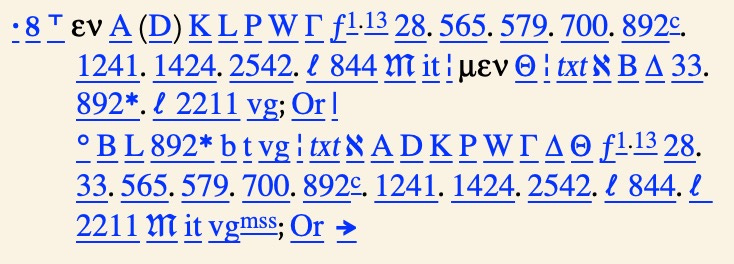
If you click the right-facing arrow, you will be taken to Appendix II and directly to the part for Mark 1:8. Or you can hover over it and see the info in the Instant Details box.
For abbreviations (Latin, church fathers, versions) — you can hover over an abbreviation and the meaning of the abbreviation will be presented in the Instant Details box (or you can click the abbreviation to be taken to Appendix IV). This makes it much easier to read NA28’s apparatus without having to constantly turn to the NA28 Introduction, Appendix II, and Appendix IV 😎
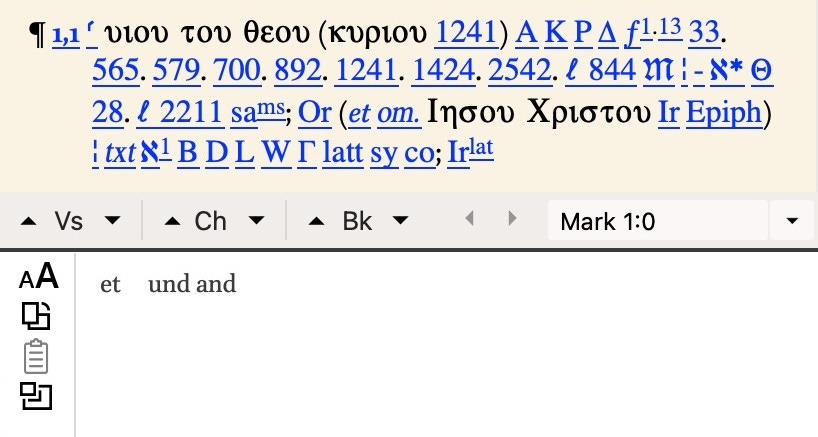
I don’t use Logos, but I’m assuming it has similar functionality for its edition of NA28. Can someone confirm?
6. TWO EXAMPLES IN EPHESIANS 1:1
Here, I will fully explain everything (sigla, abbreviations, layout) in two variant units of Ephesians 1:1.
Eph 1:1 has three examples of a transposition ⸉ … ⸊, a one -word substitution ⸀, and an omission of more than two words ⸋ … ⸌
But I’ll just focus two: the transposition and the omission of two words because the one-word substitution isn’t very complex and everything in it has already been explained earlier.


6.1 THE LAYOUT OF THE SIGLA AND APPARATUS
First, you see three text-critical sigla in the main text:
⸉ Χριστοῦ Ἰησοῦ ⸊
⸀ τοῖς
⸋ ἐν Ἐφέσῳ ⸌
Then you see the same sigla in the apparatus under the appropriate chapter/verse number, which is 1,1 in this case (NOTE: Germans separate chapter/verse numbers by a comma 1,1 — whereas most others separate with a colon 1:1).
Each variant unit is separated by a solid vertical line | so there are three variant units here + two minor variants indicated by parentheses. Although — the minor variant in vg(cl) is not found in Appendix II nor explained, so there seems to be an omission here in NA28.
Inside each variant unit, each individual variant is separated by a broken vertical line ¦
6.2 EPHESIANS 1:1, VARIANT UNIT #1: ⸉ Χριστοῦ Ἰησοῦ ⸊
The apparatus entry for ⸉ Χριστοῦ Ἰησοῦ ⸊ reads:

There are only two variants in this variant unit, each separated by ¦
⸉ = Ἰησοῦ Χριστοῦ (which is a transposition of NA28’s main text, Χριστοῦ Ἰησοῦ) and is supported by ℵ A F G K L Ψ 81. 104. 365. 630. 1175. 1241. 1739. 1881. 2464 𝔐 it vgcl syp
txt = Χριστοῦ Ἰησοῦ (which is the lemma or main text of NA28) and is supported by 𝔓46 B D P 0278. 33. 1505 b vgst.ww syh; Ambst
Variant #1 is supported by:
seven majuscules (ℵ A F G K L Ψ)
nine minuscules (81. 104. 365. 630. 1175. 1241. 1739. 1881. 2464)
the Majority text (𝔐)
three versions/translations (it vgcl syp)
To learn about the versions, you will have to look at the NA28 insert, NA28’s introductory section on versions (pp. 67*-78*), or hover over each abbreviations for versions in Accordance Bible software:
it = the majority of Old Latin witnesses
vgcl = the Clementine edition of the Latin Vulgate
syp = Syriac Peshitta
Variant #2 is supported by:
one papyrus (𝔓46)
four majuscules (B D P 0278)
two minuscules (33. 1505)
four versions (b vgst.ww syh)
one church father (Ambst)
NOTE: NA28 does not present an exhaustive list of witnesses in all extant manuscripts, so there are almost certainly more manuscripts which support variant #2.
In NA28’s introduction, p. 64*, you will see the “consistently and frequently cited witnesses” for Ephesians in NA28. There are 30 manuscripts listed for Ephesians, which is only a handful of the 530 manuscripts of Ephesians catalogued in the INTF’s Liste (to find this out, click the link to the INTF’s Liste and set the “Indexed Biblical Content” to Ephesians.
Although … there are probably even more manuscripts of Ephesians since not all extant manuscripts have been indexed.
The final five witnesses of variant #2 are: b vgst.ww syh; Ambst
b can be confusing because there are two Latin manuscripts abbreviated b: (1) the Old Latin manuscript Codex Veronensis = Verona, Biblioteca Capitolare VI, but this is only in the Gospels; (2) the Old Latin manuscript designated as Vetus Latina (VL) 89 = Budapest, National Széchényi Library, Cod. Lat. 1, but this only covers the Pauline epistles. Since we are in Ephesians, b = VL 89.
vgst.ww = two editions of the Latin Vulgate: the 2007 Stuttgart Vulgate, 5th edition and the 1889-1954 Wordsworth-White Vulgate edition. Notice that the two editions are separated by a full stop (an American period), so really it is vgst and vgww. You will not find vgst.ww by itself.
syh = Syriac Harklensis
There is then a semi-colon followed by Ambst. The semi-colon indicates the end of Greek and versional witnesses and a transition to patristic witnesses. The list of church fathers is in the NA28 introduction, pp. 80*-81* and we find that Ambst = Ambrosiaster, a Latin church father from the fourth century.
But where exactly in Ambrosiaster’s writings can his citation of Ephesians 1:1 be found?
NA28 doesn’t provide the precise work where Ambrosiaster cites Ephesians 1:1, but we shouldn’t fault NA28 since it is a one-volume hand edition. As far as I know, Legg was the only editor to actually indicate where specifically the user could find a patristic citation.
To find patristic citations, here are some resources:
The Biblindex website is the best resource for being able to input a specific passage and find patristic citations and basic bibliography. If you search for Ephesians 1:1, you will find Ambrosiaster along with 35 others who cite Eph 1:1. Biblindex even gives the exact book and page number you need to find Ambrosiaster’s citation of Eph 1:1 (CSEL 81.3, p. 71). But … Biblindex won’t give you the actual text where Eph 1:1 is quoted in Ambrosiaster; you’ll have to find CSEL 81.3 in a library.
Amy Donaldson’s 2-volume dissertation: “Explicit References to New Testament Variant Readings Among Greek and Latin Church Fathers” (PhD diss, University of Notre Dame, 2009) is free and downloadable at the link above. Donaldson quotes directly from the church fathers she analyzed, provides context, and provides an English translation. However, Donaldson’s scope is only passages where a church father is explicitly discussing a text-critical problem, not everywhere where a church father quotes the biblical text. These passages are interesting to read as a textual commentary.
Clavis Clavium (“key of keys”) provides very extensive bibliography for ancient and medieval authors and their writings. If you search for Ambrosiaster, you will find his Commentary on Paul, which is designated as CPL 184 in the Clavis database. The Clavis database provides much fuller bibliographic information than Biblindex — but again, you’ll have to find the resources in a library.
The one difficulty with Clavis is that you need to search names in Latin. For example, if you search “Augustine,” you’ll have zero results. His Latin name is “Augustinus.” But even searching “Augustinus,” there are 11 results. The most famous Augustine was the bishop of Hippo, so he is listed as “Augustinus episcopus Hipponensis” in the Clavis database.
Finally, there is the six-volume set: Biblia Patristica, Index des citations et allusions, edited by J. Allenbach (Paris: Éditions du CNRS, 1975-2000).
Perhaps I’ll write a blog post on finding patristic citations to provide more detail and show examples of where exactly a church fathers quotes from the New Testament.
6.3 EPHESIANS 1:1, VARIANT UNIT #2: ⸋ [ἐν Ἐφεσῳ] ⸌
This is a well-known and important variant, concerning whether the letter to the Ephesians is actually even addressed to the Ephesians.
I will not explain this variant fully because Zachary Cole already has a good video working through the NA28 apparatus for this variant, so go check it out.
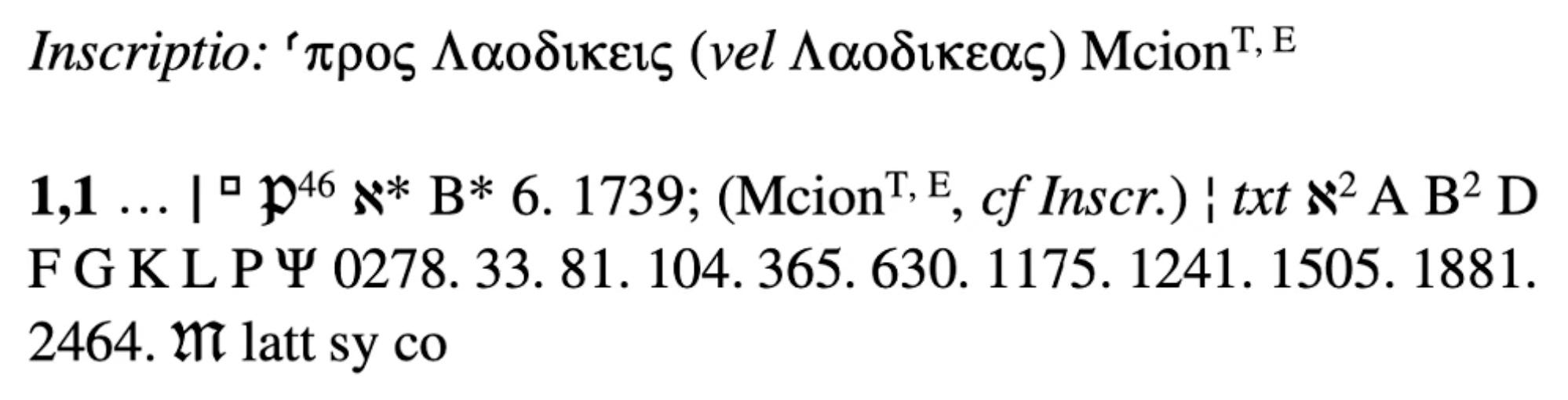
There are only two variants here:
omit ἐν Ἐφεσῳ indicated by ⸋ [ἐν Ἐφεσῳ] ⸌
include ἐν Ἐφεσῳ indicated by txt
I’ll just mention a few fun things here in summary fashion:
The square brackets around ἐν Ἐφεσῳ are not text-critical sigla, but indicate editorial uncertainty about including or omitting ἐν Ἐφεσῳ.
There are two asterisks indicating the original hand of ℵ* (Codex Sinaiticus) and B* (Codex Vaticanus), plus two corresponding corrections from the second hand of the same two manuscripts (ℵ² B²).
There is a Latin word I haven’t mentioned: vel (“or”). The reading in Mcionᵀ and Mcionᴱ could either be Λαοδικεις or Λαοδικεας.
There are two Latin abbreviations I haven’t mention: cf (“compare” from Latin confer) and Inscr. (“title, or heading” from Latin inscriptio). This is telling us that for Mcionᵀ and Mcionᴱ, we need to look at the variant title for Ephesians.
There is a minor variant in Marcion indicated with parentheses:
The minor variant references an Inscription (title) of Ephesians found in Mcionᵀ and Mcionᴱ.
What do Mcionᵀ and Mcionᴱ mean? They mean that we don’t have Marcion’s actual writings for his alternative title of Ephesians (προς Λαοδικεις). We only have Marcion according to Tertullian (Mcionᵀ) and Marcion according to Epiphanius (Mcionᴱ).
The minor variant in Marcion is actually quite interesting because his title is not “to the Ephesians” (προς εφεσιους) but “to the Laodiceans” (προς Λαοδικεις).
THE END: “CHEAT SHEET” RESOURCES
If you made it through that fire hose of content, here’s a condensed summary of all that I’ve covered. This is “cheat sheet” also for those who thought tl;dr (“too long, didn’t read”) and jumped to the end:
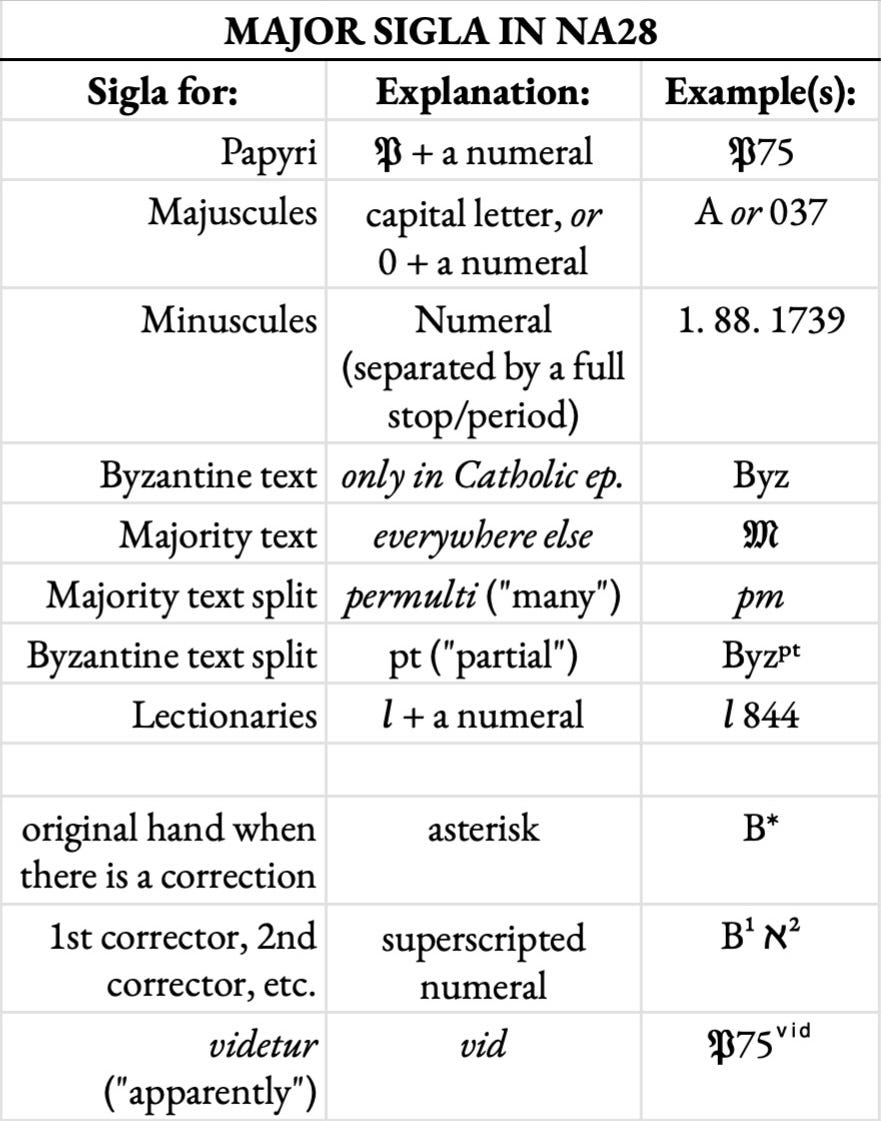
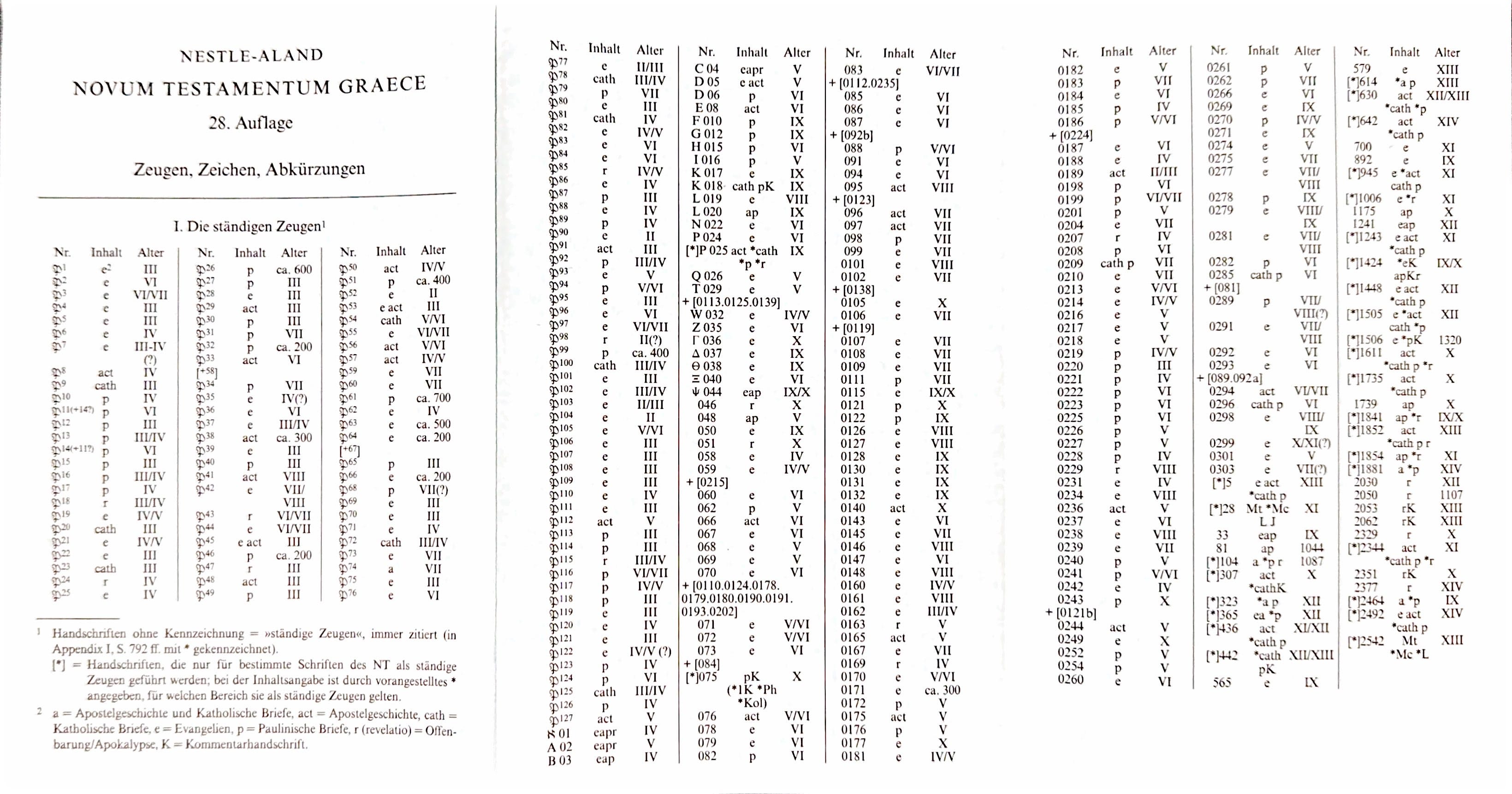
Click here for a PDF of the NA28 insert, which is found in physical copies of NA28. It’s in both English and German.
Let me know if there are any errors, inaccuracies, or anything still unclear.
Gordon D. Fee, New Testament Exegesis: A Handbook for Students and Pastors, 3rd ed. (Westminster John Knox, 2002), 60-61; David Trobisch, A User’s Guide to the Nestle-Aland 28 Greek New Testament (Society of Biblical Literature, 2013), 14-17. Also see lectures notes by Brent Nongbri on the NA apparatus. Two videos on Ephesians 1:1 — Zachary Cole on Eph 1:1 in NA28 and Zachary Cole on Eph 1:1 in UBS5. And another video by David Hutchinson on the symbols in NA28.
Using capital letters to abbreviate majuscules ended up being a bad idea because (as of Feb 21, 2026) there are 325 extant majuscule manuscripts. But when the majuscule abbreviations were created, there were far less majuscule manuscripts, so capital letters were sufficient to cover them all.
You can find out the exact number and a listing of majuscules by going to the INTF’s Liste and typing in ‘0’ in the Name field, then scroll down and click ‘Search.’
This exception was probably Constantin von Tischendorf’s sneaky way of giving Codex Sinaiticus prominence in the abbreviation and listing of majuscules 😬
By sending Codex Sinaiticus to the #1 spot, Tischendorf ensured that Codex Sinaiticus would be listed first in apparatus entries, in front of all the other majuscules already given abbreviations. Tischendorf discovered Codex Sinaiticus and it is clear that it was his favorite manuscript (‘my preeecious’).
Codex Sinaiticus Project: codexsinaiticus.org; Dirk Jongkind, Scribal Habits of Codex Sinaiticus (Gorgias, 2007); Peter Malik, “The Corrections of Codex Sinaiticus and the Textual Transmission of Revelation: Josef Schmid Revisited,” NTS 61 (2015): 595–614; H. J. M. Milne and T. C. Skeat, Scribes and Correctors of the Codex Sinaiticus (British Museum, 1938); Klaus Wachtel, “The Corrected New Testament Text of Codex Sinaiticus,” in Codex Sinaiticus: New Perspectives on the Ancient Biblical Manuscript, ed. Scot McKendrick et al. (Hendrickson, 2015), 97–106; Pietro Versace, I marginalia del Codex Vaticanus, Studi e Testi 528 (Biblioteca Apostolica Vaticana, 2018); Jesse Grenz, “The Scribes and Correctors of Codex Vaticanus” (PhD diss, University of Cambridge, 2021); D. C. Parker, Codex Bezae: An Early Christian Manuscript and Its Text (Cambridge University Press, 1992).
And see the general study of corrections in Peter Malik, “Myths About Copying: The Mistakes and Corrections Scribes Made,” in Myths and Mistakes in New Testament Textual Criticism, ed. Elijah Hixson and Peter J. Gurry (IVP Academic, 2019), 152–70.
Edgar Battad Ebojo, “A Scribe and His Manuscript: An Investigation into the Scribal Habits of Papyrus 46 (P. Chester Beatty II – P. Mich. Inv. 6238)” (PhD thesis, University of Birmingham, 2014); Peter Malik, P.Beatty III (𝔓47): The Codex, Its Scribe, and Its Text, NTTSD 52 (Brill, 2017); Loretta H.Y. Man, “The Textual Significance of Corrected Readings in the Evaluation of the External Evidence: Romans 5,1 as a Test Case,” ZNW 107 (2016).
This is a very helpful guide. I’m a Logos user and I can say that the digital NA28 apparatus is much easier to use than the print one. Also the NA28 in Logos opens without the apparatus displayed. It’s only when you click on a siglum (or hover over one with your cursor) that the apparatus information appears.
I’m preparing to take my first Greek course at Seminary, and I purchased my first NA28. This guide was extremely helpful, and I feel that I can understand the strange symbols, letters, and numbers in the apparatus.
Many thanks for your work, brother, I will certainly have to keep this bookmarked for future reference!