

Recently I gave a lecture to graduate students on the endings of Mark and I was speaking to a friend who expressed an interesting and unique view: he didn’t think the Long Ending was original to Mark but was anonymously created when the fourfold gospel came together (probably in the second century) — so far, this is nothing new.
But he went further — he was open to the possibility that the Long Ending of Mark was “an inspired process” similar to the editorial seams of the Old Testament (such as the account of Moses’s death in Deuteronomy 34, which couldn’t have been written by Moses himself). And thus, he was open to maybe receiving the Long Ending of Mark as canonical Scripture — even though it was not an original part of Mark’s Gospel.
I had never heard this view before and I asked him if anyone had published something expressing this viewpoint and he couldn’t think of anything — except maybe that Jonathan Borland (PhD, New Orleans Baptist Theological Seminary) had expressed this view in a conference paper presentation.
In search of an advocate for the Long Ending of Mark as an inspired, canonical addition to Mark’s Gospel
I had an inkling that it had to be someone outside of the modern period, someone like Samuel Tregelles from the 19th century since he was a strong conservative with a high view of Scripture (esp. on inspiration).1
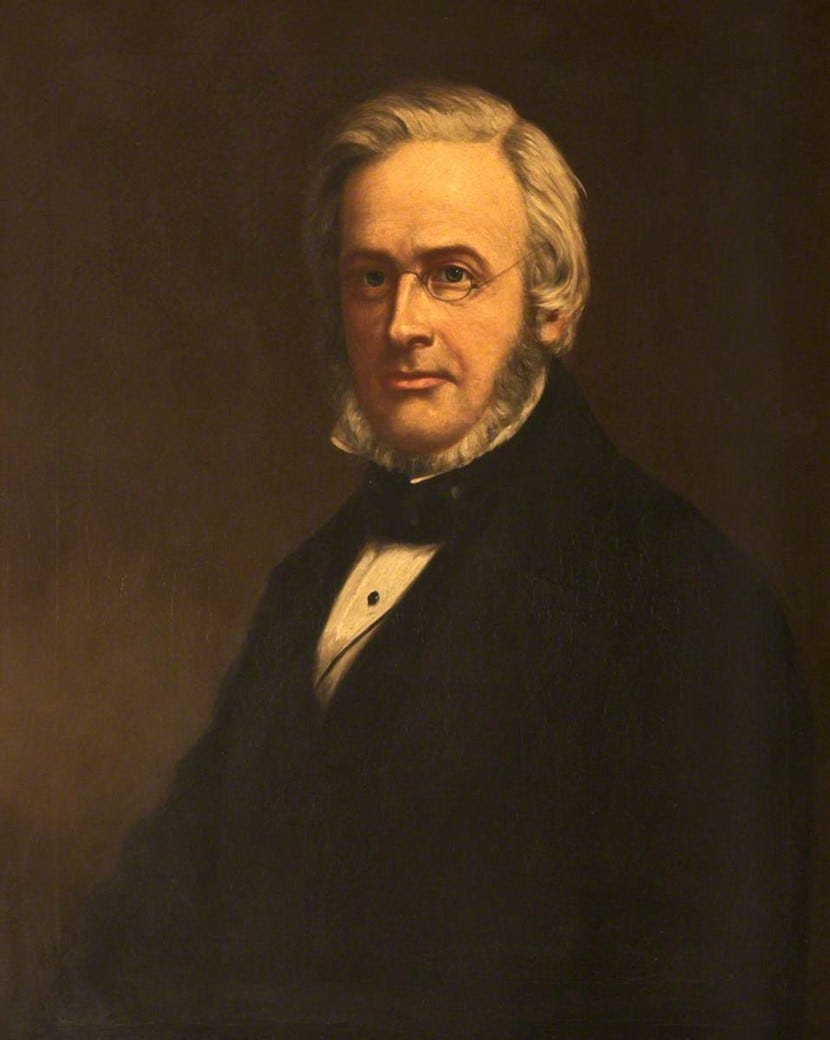
After some searching, yes … Tregelles has a similar view as my friend. Tregelles only briefly discusses the Long Ending of Mark in his Introduction to New Testament Textual Criticism.2 But he gives a fuller treatment in his 1854, An Account of the Printed Text of the Greek New Testament.3 The book is public domain, so you can read it on archive.org (see pages 246-81).
Tregelles was no friend of the Textus Receptus (TR), yet he accepted the Long Ending of Mark as canonical
Tregelles is an interesting case because he was not a Textus Receptus (TR) advocate; he was one of the first to break away from the TR in his edition published in six volumes:
Matthew & Mark (1857)
Luke & John (1861)
Acts & Catholic Epistles (1865)
Romans - 2 Thessalonians (1869)
Hebrews - Philemon (1870)
Revelation (1872) — although he published an earlier edition of Revelation as well in 1844.
These were published after Lachmann’s decisive break from the TR in 1831, but Tregelles’ edition was also published several decades before Westcott & Hort published their monumental and highly consequential edition in 1881.
So, despite not being a TR advocate … Tregelles still considered the Long Ending of Mark to be authentic, divinely inspired, canonical Scripture.
Precisely because Tregelles was not an advocate for the Textus Receptus and aimed to produce a text with “proven antiquity,” I find Tregelles to be a compelling voice to listen to regarding the Long Ending of Mark.
This article attempts to understand Tregelles’ arguments on the Long Ending of Mark, and to raise some lingering questions about his view.
What does Tregelles say about the Long Ending of Mark?
After practicing traditional textual criticism — surveying external and internal evidence, including patristic discussions — Tregelles concludes:
I. That the book of Mark himself extends no farther than ἐφοβοῦντο γάρ, xvi. 8.
II. That the remaining twelve verses, by whomsoever written, have a full claim to be received as an authentic part of the second Gospel, and that the full reception of early testimony on this question does not in the least involve their rejection as not being a part of Canonical Scripture.4
Tregelles does not think that Mark wrote the Long Ending, but an anonymous scribe (pp. 258-59). And he thinks it was created during the “apostolic period” — a term which he doesn’t define, but presumably this would be late first century, and could maybe be stretched into the early second century.5
Tregelles then discusses how it is difficult for some scholars to accept an anonymous document as Scripture (p. 259). Tregelles counters by saying: “if inspired, the true and potential author was God, and not the individual writer, known or anonymous” (p. 260). Tregelles concludes by saying:
[Certain writings] which were originally received on good grounds as such [i.e. claiming apostolic authority and eyewitness testimony], and which have been authentically transmitted to us, we may confidently and reverently receive, even though we may not know by what pen they were recorded.6
In other words, despite not knowing who wrote the Long Ending of Mark, Tregelles was still willing to affirm the Long Ending as authentic, divinely inspired Scripture.
What arguments does Tregelles give?
Tregelles’ argument is quite complex and I won’t go deeply into it (you can read Tregelles yourself on archive.org, pages 246-61). Tregelles has a section on why the Long Ending was not original to Mark’s Gospel and there is no need to reiterate those arguments (pp. 253-58). But here are some observations on Tregelles’ other arguments:
(1) Tregelles points to the Old Testament precedent of “anonymous yet canonical additions”
On page 259 of An Account of the Printed Text of the Greek New Testament, he writes:
I thus look on this section [Mark 16:9-20] as an authentic anonymous addition to what Mark himself wrote down from the narration of St. Peter (as we learn from the testimony of their contemporary, John the Presbyter); and that it ought as much to be received as part of our second Gospel, as the last chapter of Deuteronomy (unknown as the writer is) is received as the right and proper conclusion of the books of Moses.
It is hard to affirm that Moses wrote about his own death in Deuteronomy 34, and even conservatives accept that Deut 34 was written by an anonymous figure sometime after Moses completed his work on the Pentateuch.
I will label this as an “anonymous yet canonical addition” to the Old Testament, even though Tregelles doesn’t use this exact terminology.
This idea reminded me of an article on “inspired textual updating” by my MDiv professor, Michael Grisanti: “Inspiration, Inerrancy, and the OT Canon: The Place of Textual Updating in an Inerrant View of Scripture,” JETS 44 (2001): 577–98. Grisanti gives many examples of anonymous textual updates that are nevertheless received as canonical (Gen 14:14; Gen 11:28, 31; Deut 2:10-12; Deut 3:8-11; Gen 36:31; Gen 15:2b).
Tregelles’ appeal to “anonymous yet canonical additions” to the Old Testament also reminded me of a similar point made by James Snapp in his “A Case for the Longer Ending of Mark”:
[The Long Ending of Mark] may be auxiliary, but it is still original, authentic, and canonical. In this, it is like various other passages in the Bible such as Deuteronomy 34:5–12, Joshua 24:29–33, Proverbs 30–31, Jeremiah 52, etc.
However, neither Tregelles nor Snapp provide criteria by which to identify an “anonymous yet canonical addition.”
Perhaps some sort of “criteria of canonicity” could be applied to the Long Ending of Mark? 🤔 These are criteria such as apostolic origin, orthodox doctrine, catholicity (wide acceptance), and usage in worship/church.
(2) On internal grounds, Tregelles argues that the Long Ending of Mark seems to be “authentic history” given its difficulties and seeming contradictions when compared to the other Gospels.
On page 258 of An Account of the Printed Text of the Greek New Testament, Tregelles says:
the contents of this section [Mark 16:9-20] are such as preclude its having been added at a post-apostolic period, and that the very difficulties7 which it contains afford a strong presumption that it is an authentic history: the force of this argument is such that I do not see how it can be avoided;
for even if a writer went out of his way to make difficulties in a supplement to St. Mark’s Gospel, it is but little likely that his contemporaries would have accepted and transmitted such an addition, except on grounds of known and certain truth as to the facts recorded.
If there are points not easy to be reconciled with the other Gospels, it is all the less probable that any writer should have put forth, and that others should have received, the narrative, unless it were really authentic history.
Elsewhere, Tregelles says something similar: scribes “presume to add and alter in order to remove contradictions, but not in order to make them.”
In other words, Tregelles seems to be using a prefer the “more difficult reading” in favor of the Long Ending of Mark. According to Tregelles, why would someone create a Markan supplement that seemingly contradicts the other Gospels? And why would scribes continue to copy and transmit such difficulties?
For Tregelles, the best explanation is that the difficulties suggest that a genuine, authentic history was created and continuously copied.
(3) Tregelles puts much value on the positive reception of the Long Ending of Mark in the church fathers.
On pages 251-53 of An Account of the Printed Text of the Greek New Testament, Tregelles surveys patristic evidence that demonstrates the existence and reception of the Long Ending of Mark in the second and third centuries:
Irenaeus quotes from Mark 16:19 in Against Heresies 3.10.6 (and Irenaeus seems to accept Mark 16:19 as Scripture)
Celsus maybe knew and accepted the Long Ending of Mark, as described in Origen’s Against Celsus 2.59 and 2.70. I haven’t seen Celsus mentioned before as evidence in favor of the Long Ending of Mark, so this was interesting. Against Celsus 2.70 especially seems convincing that Celsus knew Mark 16:9. But Tregelles notes that Origen was confused about Celsus’ objection and tries to refute Celsus from Matthew’s Gospel (suggesting that Origen didn’t know of Mark 16:9).
Hippolytus in his ‘Apostolic Tradition concerning the gifts’ (περὶ χαρισμάτων ἀποστολικὴ παράδοσις) quotes from Mark 16:17-18 — although this comes to us through a later writer who incorporates Hippolytus into the Apostolic Constitutions Book 8.
Finally, Tregelles mentions (but does not expand upon) the use of the Long Ending of Mark during the fourth and fifth centuries in Cyril of Jerusalem, Ambrose, Augustine, and Nestorius (as cited by Cyril of Alexandria).
There is, of course, far more patristic testimony on the Long Ending of Mark, but Tregelles only cites the aforementioned individuals.
For Tregelles, this patristic evidence is enough to convince him that the Long Ending of Mark is authentic: “the early reception and transmission of this section [Mark 16:9-20], uphold its authenticity, and as it has been placed from the second century, at least, at the close of our second canonical Gospel.”8
Evaluating Tregelles on the Long Ending of Mark
I am intrigued by Tregelles’ view, but still have some unanswered questions:
By what criteria can we identify an “anonymous yet canonical addition”? There are several other passages that could fit this category (e.g., doxology of Romans; John 5:3b-4; Pericope of the adulteress).
Is Tregelles hinting towards canon controversies as being applicable to the Long Ending of Mark? Tregelles doesn’t bring up what we call “criteria of canonicity” (apostolic origin, orthodox doctrine, catholicity/wide acceptance, and usage in worship/church) — but maybe that is what he had in mind?
Because the issue is not just about a church father knowing or having the Long Ending of Mark in his biblical text; the issue is whether a church father accepts and quotes from the Long Ending of Mark as scripture (e.g. like Irenaeus and many others in the fourth/fifth centuries).
This is the same reasoning used to establish a canon consciousness in the first and second century: books that would eventually become canonical were quoted as Scripture and were read as Scripture in church.
In other words: Was the Long Ending of Mark quoted as scripture and read as scripture in the early church? The preliminary answer is yes (at least in the case of Irenaeus and maybe Justin Martyr and Tatian), but what is unclear is how widespread this was.
What does Tregelles mean by “authentic”? He obviously does not think that “authentic” = “original” since he explicitly says the Long Ending of Mark isn’t original to Mark. So does he simply mean that the events narrated in the Long Ending of Mark actually happened? Tregelles believes that the Pericope of the Adulteress was a true account of Jesus’s life, yet rejected it as Scripture/canonical. Tregelles seems to mean something like “authentic = canonical or divinely inspired” — maybe? I don’t know.
Has someone else published something with a similar view as Tregelles? (That the Long Ending of Mark is not original to Mark’s Gospel, but should still be considered authentic and canonical).
What do you think? Is Tregelles off the rails? Or is he on to something worth further developing?
EDIT #1: Peter Gurry mentioned that the ETC blog had some discussion on this back in 2016: https://evangelicaltextualcriticism.blogspot.com/2016/05/is-longer-ending-of-mark-inspired-with.html
FOONOTES
For example, read his attitude towards the text-critical task in his introductory notice:
“It is not for Christian scholars to fear true criticism or its results: the object of true criticism is not to alter scripture dogmatically on the judgment of any individual, but it is to use the EVIDENCE which has been transmitted to us, as to what the holy men of God, inspired by the Holy Ghost actually wrote. In this, as in any other Christian service, the blessing and guidance of God may be sought, by those who know the privileges resulting to the believing soul from the redemption of His Son.”
— Samuel Prideaux Tregelles, The Greek New Testament, Volume 1: Matthew-Mark (London: Samuel Bagster and Sons, 1857), ii.
Samuel Prideaux Tregelles, An Introduction to the Textual Criticism of the New Testament (London: Longmans, Green, 1856), 434-36.
Samuel Prideaux Tregelles, An Account of the Printed Text of the Greek New Testament, With Remarks on Its Revision upon Critical Principles (London: Samuel Bagster and Sons, 1854), 246-81. You can read it here: https://archive.org/details/a609739200treguoft/page/246/mode/2up.
Tregelles, An Account of the Printed Text of the Greek New Testament, 258.
I am implying this from what Tregelles says on p. 258: “the contents of this section [Mark 16:9-20] are such as preclude its having been added at a post-apostolic period.”
Tregelles, An Account of the Printed Text of the Greek New Testament, 261.
Some of the “difficulties” that Tregelles mentions are: “that the appearance of our Lord to Mary Magdalene first, is not (it is said) in accordance with what we learn elsewhere ; that the supposition of miraculous powers to be received (ver. 17, 18) is carried too far ;—that (in ver. 16) Baptism is too highly exalted” (An Account of the Printed Text of the Greek New Testament, 256, emphases original).
Tregelles, An Account of the Printed Text of the Greek New Testament, 258.
Thank you for clearly presenting this perspective. I know that Childs also assumes the canonicity of marks ending (and pericope, etc) from a same line of thinking, although obviously with a different nuance regarding inspiration.